|
Author
|
Message
|
|
Joe-JDC
|
|
|
Group: Forum Members
Last Active: Yesterday
Posts: 796,
Visits: 23.2K
|
I think you completely misunderstood what I said in my post about the void under that spacer between the intake manifold and the spacer. That void is a disruption in the actual fuel distribution and will cause puddling, turbulence, and wetting down of the gasket under that spacer. The spacer should sit flat on the carb pad, not raised around the edge of the original pad. Have the shop mill the carb pad down flat like my picture and the issue will resolve itself. JMO, but BTDT. Joe-JDC
JDC
|
|
|
|
|
RossL
|
|
|
Group: Forum Members
Last Active: 2 days ago
Posts: 164,
Visits: 7.3K
|
Joe-JDC (9/17/2026)
I think you completely misunderstood what I said in my post about the void under that spacer between the intake manifold and the spacer. That void is a disruption in the actual fuel distribution and will cause puddling, turbulence, and wetting down of the gasket under that spacer. The spacer should sit flat on the carb pad, not raised around the edge of the original pad. Have the shop mill the carb pad down flat like my picture and the issue will resolve itself. JMO, but BTDT. Joe-JDC You are correct. I didn't understand what you meant about the void between the intake and the spacer. Since this has been a really frustrating experience............... I am not prepared to spend any more time and money on this manifold. I am not doubting you, but I do not want to take even the slightest chance of your suggestion not working. My immediate plan is to try to tune the carb with the AFR. Longer term, I am considering purchasing a TSP or Mummert intake manifold
|
|
|
|
|
KULTULZ
|
|
|
Group: Forum Members
Last Active: Yesterday
Posts: 2.0K,
Visits: 306.6K
|
A ‘B’ manifold (and a modern carb) on a ‘55 Bird is not exactly “OEM”, and with a bit of red paint that alum. BT would likely fool most as authentic FoMoCo (?), though the iron one IS unique, admittedly"It is a POWER UPGRADE for the H4000 and LOM. If done correctly, the changeover will APPEAR as OEM. That is what is being attempted here, trying to improve power and drive-ability. Nothing wrong with it (IMO), especially if the car can be reverted to correct assembly at a later date (cause no harm). No, It will not pass muster as a dedicated restoration, but many would not actually see/realize the upgrade outright.
____________________________
|
|
|
|
|
KULTULZ
|
|
|
Group: Forum Members
Last Active: Yesterday
Posts: 2.0K,
Visits: 306.6K
|
"I am considering purchasing a TSP or Mummert intake manifold"Remember, the MUMMERT does not have the heated crossover for a hot air choke. Might be important considering where you live.
The TPS is cast in CHINA and machined in AU I believe,
____________________________
|
|
|
|
|
Ted
|
|
|
Group: Administrators
Last Active: 2 days ago
Posts: 7.6K,
Visits: 206.0K
|
|
|
|
|
|
RossL
|
|
|
Group: Forum Members
Last Active: 2 days ago
Posts: 164,
Visits: 7.3K
|
I installed an AFR. Per the AFR the carb was rich across the board. This is my first exposure to an AFR and not sure what to expect. Edelbrock suggested to adjust the idle to 14 and other conditions may vary between high 12's to mid 13's
At idle it's impossible to get to 14.00. Watching the vacuum gauge and AFR the best I could get was toggling between 12.75 to 13.50. To get there the vacuum gauge is down to 18 from 20. The idle mixture screws have to choke the engine to get to this point and it's very sensitive if I go a tiny bit more lean, the engine wants to stall out.
As soon as I apply the gas the reading goes rich to (10 or 11), I assume this is the extra fuel from the pump shot. Once the engine settles from the acceleration, it cruises between 13.50 to 15.00.
Any acceleration causes the gauge to read 10/11 (10 is richest setting on the gauge), then it goes back to 13-15.
I installed the new carb and the jetting out of the box was same as first one. I had to lean it out 2 stages lean in cruise and power mode and also in the secondary jets. Still completely dies if a hard WOT is applied from a dead stop.
I am assuming there could be some fuel pooling in the manifold at idle I cannot adjust out, without stalling the engine.. (I always adjust the idle RPM in neutral at 800-900 RPM sop when I shift into drive the rpm at idle is 650-700. I am also assuming the hard WOT is causing turbulence in the manifold.... Both carbs run pretty good if the gas is feathered under any condition. It seems to run OK when the air is allowed to gradually increase NOT the sudden rush created by instant WOT
Any constructive thoughts are welcome............... I ordered a new TSP manifold, Mummert is out of stock for 5-6 weeks.......arriving Friday
|
|
|
|
|
Joe-JDC
|
|
|
Group: Forum Members
Last Active: Yesterday
Posts: 796,
Visits: 23.2K
|
Again, read my description of what happens with the void under the carb spacer out to the edge of the carb flange area. Wetting, puddling, and rich mixtures. BTDT and watched it on dyno testing. Check out Jon Kaase's You Tube on sticking his finger in a manifold while the engine is on the dyno and the fuel wash in the ports under the carburetors. On my tunnel ram with wrong spacers, it was soaking wet due to the reversion under the carb. The fuel needs to be directed into the manifold plenum, and not sucked up under the spacer and wetting the gasket and puddling. Mill the carb plenum flat and get rid of the void and use a spacer and the problem will mostly go away. That divider cut down will never get rid of the torque dip. Joe-JDC
JDC
|
|
|
|
|
RossL
|
|
|
Group: Forum Members
Last Active: 2 days ago
Posts: 164,
Visits: 7.3K
|
Joe-JDC (9/22/2026)
Again, read my description of what happens with the void under the carb spacer out to the edge of the carb flange area. Wetting, puddling, and rich mixtures. BTDT and watched it on dyno testing. Check out Jon Kaase's You Tube on sticking his finger in a manifold while the engine is on the dyno and the fuel wash in the ports under the carburetors. On my tunnel ram with wrong spacers, it was soaking wet due to the reversion under the carb. The fuel needs to be directed into the manifold plenum, and not sucked up under the spacer and wetting the gasket and puddling. Mill the carb plenum flat and get rid of the void and use a spacer and the problem will mostly go away. That divider cut down will never get rid of the torque dip. Joe-JDC I did read what you said................ From my view it's not worth the trouble of removing the manifold, finding and paying another shop to modify the manifold, reinstalling the manifold, for the problem to "mostly go away". Then I "may" still have to deal with whatever the cut down divider may or may not cause............which I will not know until I get the car back together again. I already ordered the TSP manifold so that's my plan for now. The two 57 B manifolds I found locally were rusted internally and had to get it blasted to clean up the internal passages, people selling these B manifolds want top dollar for them. If you find a B that has internal rust find out how much it will cost to clean it and modify it.
|
|
|
|
|
Joe-JDC
|
|
|
Group: Forum Members
Last Active: Yesterday
Posts: 796,
Visits: 23.2K
|
I am retired officially, but I ported heads and intakes for the last 54 years, specializing in Fords. I always sand blast any iron intake manifold that is going to be ported before I do anything with it. I sandblast the interior as well as the exterior and sometimes re-sandblast the interior to get a certain surface finish in the ports. As far as the new TSP intakes, I have ported a couple of them already, and flowed several on my SF-600 flow bench. It is a very good copy of the ECZ-B iron intake as far as flow at 189cfm, but not any better because of the small carburetor holes and small runners. I had difficulty getting over 210 cfm with porting, and had to remove some of the ribbing at the down turns to get the flow up to 230cfm average. I just flowed one of the newer Mummert dual plane intakes, and it averages over 283cfm. The one I received from John last year averaged 272cfm. You will need a spacer to fit any of the new Holley or Edelbrock or Summit carburetors unless you go with the 390cfm Holley with small butterflies. You may have to bevel or enlarge the four holes for the spacers and carb to work properly. Joe-JDC
JDC
|
|
|
|
|
RossL
|
|
|
Group: Forum Members
Last Active: 2 days ago
Posts: 164,
Visits: 7.3K
|
Joe-JDC (9/22/2026)
I am retired officially, but I ported heads and intakes for the last 54 years, specializing in Fords. I always sand blast any iron intake manifold that is going to be ported before I do anything with it. I sandblast the interior as well as the exterior and sometimes re-sandblast the interior to get a certain surface finish in the ports. As far as the new TSP intakes, I have ported a couple of them already, and flowed several on my SF-600 flow bench. It is a very good copy of the ECZ-B iron intake as far as flow at 189cfm, but not any better because of the small carburetor holes and small runners. I had difficulty getting over 210 cfm with porting, and had to remove some of the ribbing at the down turns to get the flow up to 230cfm average. I just flowed one of the newer Mummert dual plane intakes, and it averages over 283cfm. The one I received from John last year averaged 272cfm. You will need a spacer to fit any of the new Holley or Edelbrock or Summit carburetors unless you go with the 390cfm Holley with small butterflies. You may have to bevel or enlarge the four holes for the spacers and carb to work properly. Joe-JDC Thank you again for your insights. I plan to use this spacer. Should I have a shop enlarge the holes in the manifold to match the spacer? If the butterflies clear the spacer would it create a problem with the smaller intake openings to leave the manifold as-is? Engine is stock rarely sees RPM's over 4,000. I am not try to build horsepower. 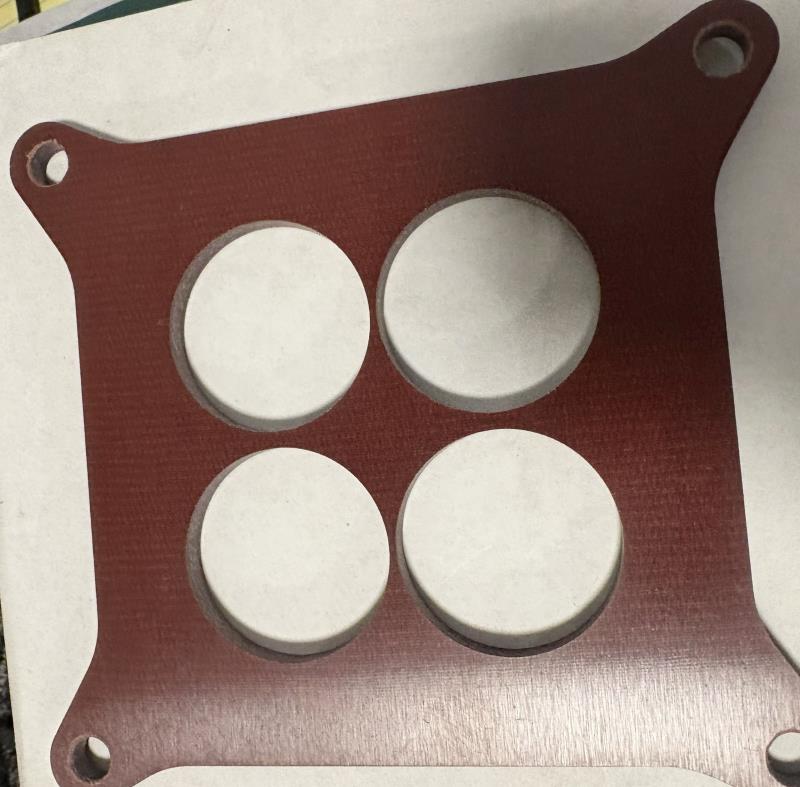 ?
|
|
|
|