|
By RossL - Last Month
|
Reason for this post.............was the manifold opened too much?
My 55 Thunderbird has a stock 292 with a Holley electric fuel pump (measured 5.5 pounds of pressure), manifold vacuum is 20
I took my new to me B manifold to get the inside blasted since it was filled with rust. I asked the machine shop to open the ports because my Edlebrock carb secondaries could not fully open. I showed them a picture that Ted posted on a previous post. They decided to open the the intake (see picture below) and cut the divider (that runs down the center of the manifold). They probably removed half of the height of the divider because it was "better"
I can't get the car to "move" when I go to WOT from a dead stop. The car actually stalls out if I don't start pumping the pedal. It runs pretty good in all other scenarios (around town, highway), it even works fine from a dead stop "if" I slowly apply the throttle.......
Moved the accelerator pump in all positions
Installed a richer Accel pump nozzle
Floats are set to 7/16" with a 15/16" drop
I've tried 3 additional jet and rod combinations per the tuning guide (one lean and two setting on the rich side)
Tried different Edelbrock step up springs (per Edelbrock and vac readings I am settling on the silver springs
Initial timing is set to 15 degrees (Ive tried 10 to 20) Distributor is a CRT
Tried adjusting the vacuum advance with the Allen/set screw and I also tried a limited plate for less vacuum advance
Tried ported and manifold vacuum for vac advance
I disconnected the trans kick down rod for a brief test
There is probably a few other things I can't remember at the moment.................so please ask away
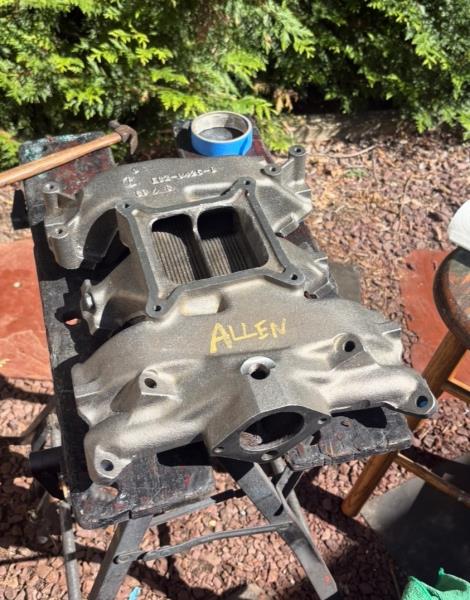
Do you think the manifold "opening" could be causing the problem? I really do NOT want to do this but today I might put the original manifold back on and use a carb adapter to put the Edelbrock on the 55 intake.... I want to see if the problem is the carb or the manifold
|
|
By Joe-JDC - Last Month
|
Two things come to mind looking at your intake. They should have milled the carb pad down to get rid of the open space around the plenum so that it seals off the underside of the carburetor. Second they should not have milled the divider down. Proven to lose torque or have a torque dip at part throttle. The carb pad can be milled completely flat and a 1/4" or 1/2" four hole spacer used to seal that area. Eric Weingartner just proved that those slots hurt performance on dyno testing, and Ted and I did dyno testing and came to the conclusion that it almost always is a loss somewhere in the rpm band. JMO, but I do not slot an intake for anyone unless it is strictly a race engine. Joe-JDC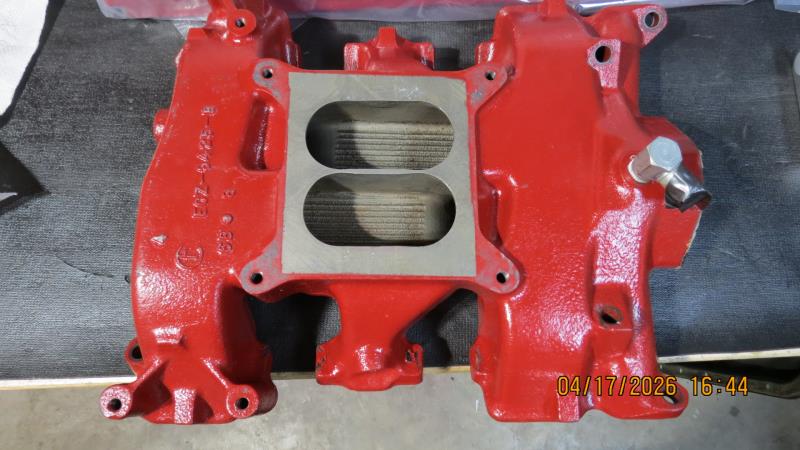
This intake manifold on my 304 cubic inch EMC engine made 438 hp in testing before the Challenge. We used a Mummert for the actual competition since it made about 14 more horsepower. This manifold is fully ported and flows ~289cfm average. The Mummert flow more.
|
|
By 55blacktie - Last Month
|
RossL (9/16/2026)
Reason for this post.............was the manifold opened too much? My 55 Thunderbird has a stock 292 with a Holley electric fuel pump (measured 5.5 pounds of pressure), manifold vacuum is 20 I took my new to me B manifold to get the inside blasted since it was filled with rust. I asked the machine shop to open the ports because my Edlebrock carb secondaries could not fully open. I showed them a picture that Ted posted on a previous post. They decided to open the the intake (see picture below) and cut the divider (that runs down the center of the manifold). They probably removed half of the height of the divider because it was "better" I can't get the car to "move" when I go to WOT from a dead stop. The car actually stalls out if I don't start pumping the pedal. It runs pretty good in all other scenarios (around town, highway), it even works fine from a dead stop "if" I slowly apply the throttle....... If you have a stock 292, you should have left the B intake alone, other than possibly blocking off the heat crossover. I bought a Mummert aluminum intake. Although I haven't installed it yet, I would have preferred that the plenum divider was not notched; but it's a small notch. Moved the accelerator pump in all positions Installed a richer Accel pump nozzle Floats are set to 7/16" with a 15/16" drop I've tried 3 additional jet and rod combinations per the tuning guide (one lean and two setting on the rich side) Tried different Edelbrock step up springs (per Edelbrock and vac readings I am settling on the silver springs Initial timing is set to 15 degrees (Ive tried 10 to 20) Distributor is a CRT Tried adjusting the vacuum advance with the Allen/set screw and I also tried a limited plate for less vacuum advance Tried ported and manifold vacuum for vac advance I disconnected the trans kick down rod for a brief test There is probably a few other things I can't remember at the moment.................so please ask away Do you think the manifold "opening" could be causing the problem? I really do NOT want to do this but today I might put the original manifold back on and use a carb adapter to put the Edelbrock on the 55 intake.... I want to see if the problem is the carb or the manifold
|
|
By 55blacktie - Last Month
|
Joe-JDC (9/16/2026)
Two things come to mind looking at your intake. They should have milled the carb pad down to get rid of the open space around the plenum so that it seals off the underside of the carburetor. Second they should not have milled the divider down. Proven to lose torque or have a torque dip at part throttle. The carb pad can be milled completely flat and a 1/4" or 1/2" four hole spacer used to seal that area. Eric Weingartner just proved that those slots hurt performance on dyno testing, and Ted and I did dyno testing and came to the conclusion that it almost always is a loss somewhere in the rpm band. JMO, but I do not slot an intake for anyone unless it is strictly a race engine. Joe-JDC This intake manifold on my 304 cubic inch EMC engine made 438 hp in testing before the Challenge. We used a Mummert for the actual competition since it made about 14 more horsepower. This manifold is fully ported and flows ~289cfm average. The Mummert flow more.
If it's "strictly a race engine", Mummert's single-plane manifold might be the way to go.
|
|
By 55blacktie - Last Month
|
|
Ross, if you have a stock 292, you should have left the B manifold as is, with the possible exceptions of blocking off the heat crossover. No offense, but compared to the B manifold that Ted Eaton modified for me, yours looks like it's been butchered.
|
|
By DANIEL TINDER - Last Month
|
|
I’m a bit puzzled why anyone would spend money modifying (especially experimentally) an iron manifold, when better performing/look-alike aluminum models are readily available, and with accurately predictable performance specs (?).
|
|
By RossL - Last Month
|
Thank you for all the responses. But I am here asking for help determining if the manifold is causing the problem I am having. At this point I am very upset with the job done by this local shop and I really don't need people to ask why and why not........................it's done and I am ready to move on if necessary.
And if you really must know, Ted suggested the mod in another post. I showed the "machinist" the picture Ted provided...............when I went to pick it up I couldn't ask him to undo it
|
|
By Big Tim - Last Month
|
"Reason for this post.............was the manifold opened too much?"
I would say it was opened too much. Normally those slots are maybe .25 deep and 1 inch long? People say they help with "tuning" but the tuning they refer to is tuning for max power at high rpm, not off idle performance on a basically stock engine.
You're engine essentially has a single plane on it now.
Having said all that, maybe try adding less pump? Or turning in the idle mix screws? Sounds like its rich and bogging off the line. If it was lean I would think it would back fire out the carb. It's also hard to say if the manifold or the new carb is the issue since they were changed together and not one before the other.
|
|
By KULTULZ - Last Month
|
'I’m a bit puzzled why anyone would spend money modifying (especially experimentally) an iron manifold, when better performing/look-alike aluminum models are readily available, and with accurately predictable performance specs (?)."
A person may want improved performance without the added appearance of aftermarket speed parts.
Like a dedicated restoration whereas the outer appearance (CASTING and DATE CODES) has to appear as OEM
"BEAUTIFUL ENGINE DETAILING! ... why is the curb idle so lumpy?"
"I think I might have a bad plug wire ..." ... 
It has to be run on a dyno or flow bench to determine any damage.
It might be a good idea to drive it with a manifold vacuum gauge attached to see if there is any vacuum leakage resulting
in LEAN TIP-IN HESITATION.
|
|
By KULTULZ - Last Month
|
"I would say it was opened too much. Normally those slots are maybe .25 deep and 1 inch long? People say they help with "tuning" but the tuning they refer to is tuning for max power at high rpm, not off idle performance on a basically stock engine.
You're engine essentially has a single plane on it now."
WHAT HE SAIDI ...
SINGLE PLANE is a bear on the street for normal driving. Maybe with TBI but not carb, unless a SATURDAY NIGHT SPECIAL (IMO)
|
|
By KULTULZ - Last Month
|
"I might put the original manifold back on and use a carb adapter to put the Edelbrock on the 55 intake.... I want to see if the problem is the carb or the manifold."
The throttle bores on the stock 55 intake are 1.5in and there is a transitional carb spacer that will allow the larger EDEL butterfly's to operate freely.
|
|
By RossL - Last Month
|
KULTULZ (9/16/2026)
" I might put the original manifold back on and use a carb adapter to put the Edelbrock on the 55 intake.... I want to see if the problem is the carb or the manifold." The throttle bores on the stock 55 intake are 1.5in and there is a transitional carb spacer that will allow the larger EDEL butterfly's to operate freely.
I don't mind changing the manifold to test, which seems to be the only way to figure out what the problem is. I don't want to buy a new manifold or go through the trouble of removing and replacing the manifold 2 more times. I was hoping someone here might say........."it's the carb", because Summit already is sending me a replacement. Since Summit is the only vendor willing to help I would rather not exploit them and "use" their replacement to trouble shoot what I believe to be someone else's problem..
|
|
By RossL - Last Month
|
Big Tim (9/16/2026)
"Reason for this post.............was the manifold opened too much?" I would say it was opened too much. Normally those slots are maybe .25 deep and 1 inch long? People say they help with "tuning" but the tuning they refer to is tuning for max power at high rpm, not off idle performance on a basically stock engine. You're engine essentially has a single plane on it now. Having said all that, maybe try adding less pump? Or turning in the idle mix screws? Sounds like its rich and bogging off the line. If it was lean I would think it would back fire out the carb. It's also hard to say if the manifold or the new carb is the issue since they were changed together and not one before the other.
Thinking about your suggestion, I did try the leanest pump shot and leaned out the primary jet and rod combination ( 1stage lean power and cruise), no change. The best the carb performed was 2 stages rich power and cruise. One thing I didn't mention, the idle mixture screws were not very responsive to change, they we almost an on/off switch. To get the idle and vac gauge to drop the screws were turned in about 1/4 turn from seated
|
|
By KULTULZ - Last Month
|
It is difficult to diagnose and suggest fuel mixture problems here. Can on;y suggest pointing to TECH INFO as how to go about it on your end.
Have you used a VACUUM GAUGE to see if any vacuum leaks? The carb pad should have been shaved (as suggested previously).
Being a BIRD, it will be difficult to find a suitable spacer (heat isolation)/gaskets due to hood clearance.
EDEL has a CARB TECH BOOK.
READ HERE - https://www.enginelabs.com/engine-tech/intake-manifolds-single-plane-or-dual-plane/
PhD VERSION HERE - https://freshscientific.org/single-vs-dual-plane-intake
I think you are going to find that by eliminating the plenum divider that it is now a single plane and street duty is going to suffer. An EDEL CARB is pretty forgiving.
|
|
By RossL - Last Month
|
KULTULZ (9/17/2026)
It is difficult to diagnose and suggest fuel mixture problems here. Can on;y suggest pointing to TECH INFO as how to go about it on your end. Have you used a VACUUM GAUGE to see if any vacuum leaks? The carb pad should have been shaved (as suggested previously). Being a BIRD, it will be difficult to find a suitable spacer (heat isolation)/gaskets due to hood clearance. EDEL has a CARB TECH BOOK. READ HERE - https://www.enginelabs.com/engine-tech/intake-manifolds-single-plane-or-dual-plane/PhD VERSION HERE - https://freshscientific.org/single-vs-dual-plane-intakeI think you are going to find that by eliminating the plenum divider that it is now a single plane and street duty is going to suffer. An EDEL CARB is pretty forgiving.
I used the vacuum gauge to adjust the idle mixture and to check timing. It was a steady reading and went down and back up when blipping the throttle.
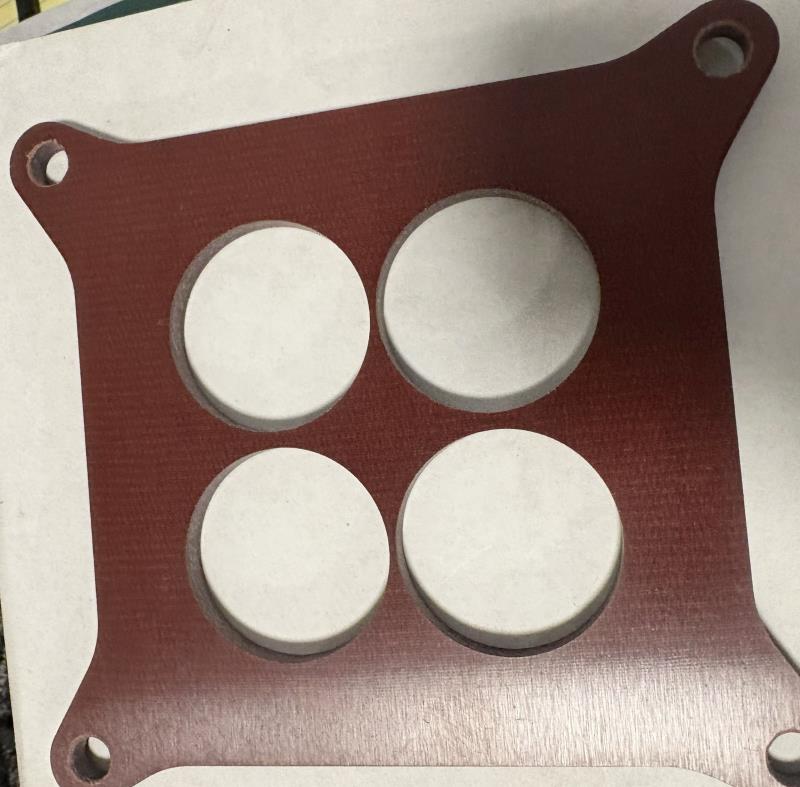
This is the spacer I used forgot to mention above. I know the manifold looks like an abortion. But the pad where the carb rests was done a CNC machine. I don't think this is the problem. This one reason why I wanted the base for the carb machined, in order to buy every 1/16" I could find. I could not get a definitive answer on what spacer would fit my car before hand
|
|
By Blind Willie - Last Month
|
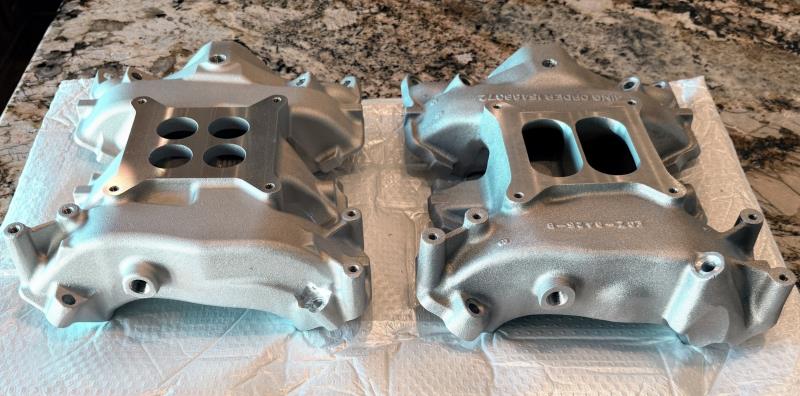
I have a TSP aluminum ECZ-9425-B knock off that i don't need and would sell at my cost plus shipping. These go for more now and there's an eBay seller that buys these from TSP and then does a crude job of slotting the bores and marks them up. The slotting is rough, almost looks a hack saw job instead of machined. The one I bought is brand new, never used or modified. i recently made a comment on a facebook forum to Joe C's response to the seller's post. My comment was that maybe I should sell mine if he's asking that much. You are welcome to it. I bought it because it was cheap at the time (discount coupon & free shipping) not less than a year ago. I have a Blue Thunder intake I plan to use on my build instead. I believe Ted Eaton has tested these and they perform as well as a stock cast iron ECZ-9425-B manifold. Picture attached shows the TSP on the left and the Blue Thunder on the right.
|
|
By KULTULZ - Last Month
|
What EDEL CARB MODEL NO. are you running?
You asked the machine shop to increase the carb pad throttle bore sizes (not opening slots) for the EDEL and they then sexually assaulted it?
I think you went about everything correctly but found a shop that didn't listen to customer want. They should have consulted/advised with you before doing what they did.
TECH ARTICLE - https://www.eatonbalancing.com/2025/09/08/more-power-for-the-ford-y-block-part-3-of-5/#more-1847
|
|
By Ted - Last Month
|
Ross. You don’t mention if this particular carburetor was run previously and if so, what the differences were in performance. Opening up that manifold with the lowered plenum divider has reduced the manifold vacuum at idle and low rpm which in turn will affect and lean the fuel mixture in the lower rpm band. But typically, fuel mixture and carb jetting changes will compensate for that. As Joe has mentioned, the torque curve gets a bit erratic in different spots in the rpm band when the plenum divider is slotted and/or lowered and there’s no amount of carburetor adjustment that will eliminate that.
Also not mentioned are the specs on the camshaft as a reduced lobe centerline on the cam will be more sensitive to intake manifold plenum changes. For street drivers, I do prefer a divided manifold plenum as that will typically result in a 1½-2” Hg manifold pressure increase which in turn gives a better signal to the carburetor.
I would suggest trying another ‘good’ carburetor on the combination as gut feel says this is a carb problem more than an intake problem. At this point in time, a carburetor change will be easier than an intake manifold change.
|
|
By DANIEL TINDER - Last Month
|
KULTULZ (9/16/2026)
'I’m a bit puzzled why anyone would spend money modifying (especially experimentally) an iron manifold, when better performing/look-alike aluminum models are readily available, and with accurately predictable performance specs (?)."
A person may want improved performance without the added appearance of aftermarket speed parts.
Like a dedicated restoration whereas the outer appearance (CASTING and DATE CODES) has to appear as OEM
A ‘B’ manifold (and a modern carb) on a ‘55 Bird is not exactly “OEM”, and with a bit of red paint that alum. BT would likely fool most as authentic FoMoCo (?), though the iron one IS unique, admittedly.
|
|
By RossL - Last Month
|
Ted (9/17/2026)
Ross. You don’t mention if this particular carburetor was run previously and if so, what the differences were in performance. Opening up that manifold with the lowered slot has reduced the manifold vacuum at idle and low rpm which in turn will affect and lean the fuel mixture in the lower rpm band. But typically, fuel mixture and carb jetting changes will compensate for that. As Joe has mentioned, the torque curve gets a bit erratic in different spots in the rpm band when the plenum divider is slotted and/or lowered and there’s no amount of carburetor adjustment that will eliminate that.
Also not mentioned are the specs on the camshaft as a reduced lobe centerline on the cam will be more sensitive to intake manifold plenum changes. For street drivers, I do prefer a divided manifold plenum as that will typically result in a 1½-2” Hg manifold pressure increase which in turn gives a better signal to the carburetor.
I would suggest trying another ‘good’ carburetor on the combination as gut feel says this is a carb problem more than an intake problem. At this point in time, a carburetor change will be easier than an intake manifold change.
The carb is an AVS2 1901. It is brand new. No idea what cam is in the car, I would have to say it's the original. Before this setup I had no problem getting 20 on the vac gauge at idle. Now it seems like I'm struggling to get to 20. I believe your estimate on1 1/2 pounds less is accurate
I just got the replacement carb from Summit and I had a bung welded to my exhaust for an AFR gauge with now needs to be wired up....
I am considering replacing the intake at some point, unless this makes a miraculous recover in the next couple of days
|
|
By Joe-JDC - Last Month
|
|
I think you completely misunderstood what I said in my post about the void under that spacer between the intake manifold and the spacer. That void is a disruption in the actual fuel distribution and will cause puddling, turbulence, and wetting down of the gasket under that spacer. The spacer should sit flat on the carb pad, not raised around the edge of the original pad. Have the shop mill the carb pad down flat like my picture and the issue will resolve itself. JMO, but BTDT. Joe-JDC
|
|
By RossL - Last Month
|
Joe-JDC (9/17/2026)
I think you completely misunderstood what I said in my post about the void under that spacer between the intake manifold and the spacer. That void is a disruption in the actual fuel distribution and will cause puddling, turbulence, and wetting down of the gasket under that spacer. The spacer should sit flat on the carb pad, not raised around the edge of the original pad. Have the shop mill the carb pad down flat like my picture and the issue will resolve itself. JMO, but BTDT. Joe-JDC
You are correct. I didn't understand what you meant about the void between the intake and the spacer. Since this has been a really frustrating experience............... I am not prepared to spend any more time and money on this manifold. I am not doubting you, but I do not want to take even the slightest chance of your suggestion not working. My immediate plan is to try to tune the carb with the AFR. Longer term, I am considering purchasing a TSP or Mummert intake manifold
|
|
By KULTULZ - Last Month
|
A ‘B’ manifold (and a modern carb) on a ‘55 Bird is not exactly “OEM”, and with a bit of red paint that alum. BT would likely fool most as authentic FoMoCo (?), though the iron one IS unique, admittedly"
It is a POWER UPGRADE for the H4000 and LOM.
If done correctly, the changeover will APPEAR as OEM. That is what is being attempted here, trying to improve power and drive-ability. Nothing wrong with it (IMO), especially if the car can be reverted to correct assembly at a later date (cause no harm).
No, It will not pass muster as a dedicated restoration, but many would not actually see/realize the upgrade outright.
|
|
By KULTULZ - Last Month
|
"I am considering purchasing a TSP or Mummert intake manifold"Remember, the MUMMERT does not have the heated crossover for a hot air choke. Might be important considering where you live.
The TPS is cast in CHINA and machined in AU I believe,
|
|
By Ted - Last Month
|
As Joe brings up, those gaps (voids) between the spacer and the intake manifold will have a negative effect on the torque curve somewhere in the rpm band as it is a flow disruption. Milling the intake flange level not only eliminates the voids that can be present between the carburetor flange and the spacer, it also minimizes the potential for any vacuum leaks.
While there are benefits to making dual ovals at the carburetor flange rather than maintaining the four hole layout, simply matching the hole sizes in the intake carburetor flange to match the carburetor itself will suffice for most daily driving. As mentioned earlier, maintaining a solid division between the left and right plenums of the intake manifold is important when considering manifold vacuum and attempting to maintain a smoother and less erratic torque curve. As a general rule, slotting or lowering the plenum divider is good for top end horsepower but hurts the torque numbers.
Here’s a graph showing the effect on the torque curve when a slot is put into the plenum divider. This testing was performed with an appropriately modified spacer to simulate what happens to a divider when slotting it.
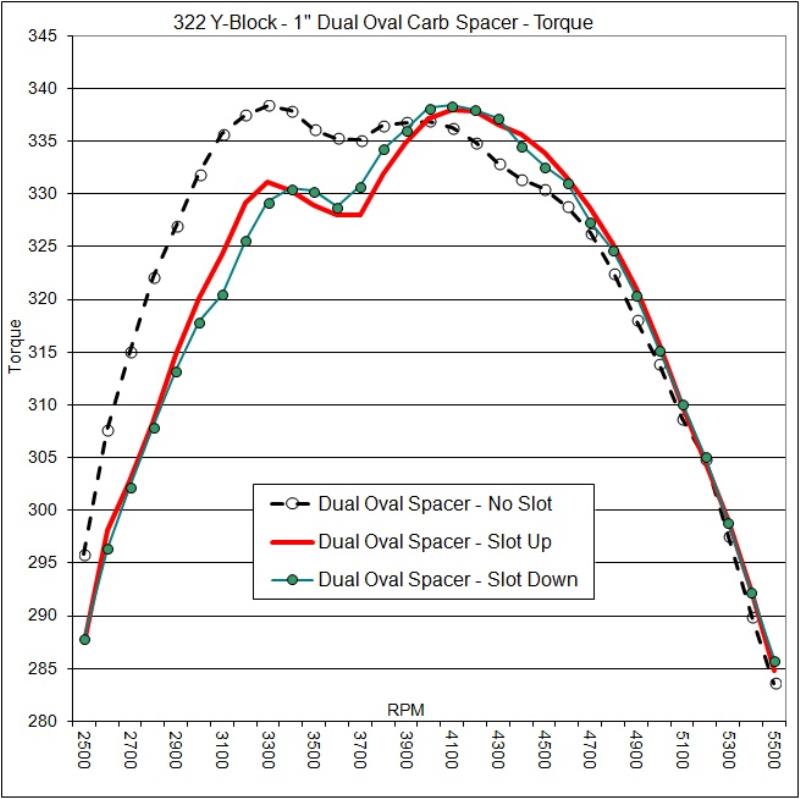
And here’s the link to the complete article giving more on the dyno testing that provided that information.
Intake Manifold Plenum Slots – Eaton Balancing
|
|
By RossL - Last Month
|
I installed an AFR. Per the AFR the carb was rich across the board. This is my first exposure to an AFR and not sure what to expect. Edelbrock suggested to adjust the idle to 14 and other conditions may vary between high 12's to mid 13's
At idle it's impossible to get to 14.00. Watching the vacuum gauge and AFR the best I could get was toggling between 12.75 to 13.50. To get there the vacuum gauge is down to 18 from 20. The idle mixture screws have to choke the engine to get to this point and it's very sensitive if I go a tiny bit more lean, the engine wants to stall out.
As soon as I apply the gas the reading goes rich to (10 or 11), I assume this is the extra fuel from the pump shot. Once the engine settles from the acceleration, it cruises between 13.50 to 15.00.
Any acceleration causes the gauge to read 10/11 (10 is richest setting on the gauge), then it goes back to 13-15.
I installed the new carb and the jetting out of the box was same as first one. I had to lean it out 2 stages lean in cruise and power mode and also in the secondary jets. Still completely dies if a hard WOT is applied from a dead stop.
I am assuming there could be some fuel pooling in the manifold at idle I cannot adjust out, without stalling the engine.. (I always adjust the idle RPM in neutral at 800-900 RPM sop when I shift into drive the rpm at idle is 650-700. I am also assuming the hard WOT is causing turbulence in the manifold.... Both carbs run pretty good if the gas is feathered under any condition. It seems to run OK when the air is allowed to gradually increase NOT the sudden rush created by instant WOT
Any constructive thoughts are welcome............... I ordered a new TSP manifold, Mummert is out of stock for 5-6 weeks.......arriving Friday
|
|
By Joe-JDC - Last Month
|
|
Again, read my description of what happens with the void under the carb spacer out to the edge of the carb flange area. Wetting, puddling, and rich mixtures. BTDT and watched it on dyno testing. Check out Jon Kaase's You Tube on sticking his finger in a manifold while the engine is on the dyno and the fuel wash in the ports under the carburetors. On my tunnel ram with wrong spacers, it was soaking wet due to the reversion under the carb. The fuel needs to be directed into the manifold plenum, and not sucked up under the spacer and wetting the gasket and puddling. Mill the carb plenum flat and get rid of the void and use a spacer and the problem will mostly go away. That divider cut down will never get rid of the torque dip. Joe-JDC
|
|
By RossL - Last Month
|
Joe-JDC (9/22/2026)
Again, read my description of what happens with the void under the carb spacer out to the edge of the carb flange area. Wetting, puddling, and rich mixtures. BTDT and watched it on dyno testing. Check out Jon Kaase's You Tube on sticking his finger in a manifold while the engine is on the dyno and the fuel wash in the ports under the carburetors. On my tunnel ram with wrong spacers, it was soaking wet due to the reversion under the carb. The fuel needs to be directed into the manifold plenum, and not sucked up under the spacer and wetting the gasket and puddling. Mill the carb plenum flat and get rid of the void and use a spacer and the problem will mostly go away. That divider cut down will never get rid of the torque dip. Joe-JDC
I did read what you said................ From my view it's not worth the trouble of removing the manifold, finding and paying another shop to modify the manifold, reinstalling the manifold, for the problem to "mostly go away". Then I "may" still have to deal with whatever the cut down divider may or may not cause............which I will not know until I get the car back together again. I already ordered the TSP manifold so that's my plan for now.
The two 57 B manifolds I found locally were rusted internally and had to get it blasted to clean up the internal passages, people selling these B manifolds want top dollar for them. If you find a B that has internal rust find out how much it will cost to clean it and modify it.
|
|
By Joe-JDC - Last Month
|
|
I am retired officially, but I ported heads and intakes for the last 54 years, specializing in Fords. I always sand blast any iron intake manifold that is going to be ported before I do anything with it. I sandblast the interior as well as the exterior and sometimes re-sandblast the interior to get a certain surface finish in the ports. As far as the new TSP intakes, I have ported a couple of them already, and flowed several on my SF-600 flow bench. It is a very good copy of the ECZ-B iron intake as far as flow at 189cfm, but not any better because of the small carburetor holes and small runners. I had difficulty getting over 210 cfm with porting, and had to remove some of the ribbing at the down turns to get the flow up to 230cfm average. I just flowed one of the newer Mummert dual plane intakes, and it averages over 283cfm. The one I received from John last year averaged 272cfm. You will need a spacer to fit any of the new Holley or Edelbrock or Summit carburetors unless you go with the 390cfm Holley with small butterflies. You may have to bevel or enlarge the four holes for the spacers and carb to work properly. Joe-JDC
|
|
By RossL - Last Month
|
Joe-JDC (9/22/2026)
I am retired officially, but I ported heads and intakes for the last 54 years, specializing in Fords. I always sand blast any iron intake manifold that is going to be ported before I do anything with it. I sandblast the interior as well as the exterior and sometimes re-sandblast the interior to get a certain surface finish in the ports. As far as the new TSP intakes, I have ported a couple of them already, and flowed several on my SF-600 flow bench. It is a very good copy of the ECZ-B iron intake as far as flow at 189cfm, but not any better because of the small carburetor holes and small runners. I had difficulty getting over 210 cfm with porting, and had to remove some of the ribbing at the down turns to get the flow up to 230cfm average. I just flowed one of the newer Mummert dual plane intakes, and it averages over 283cfm. The one I received from John last year averaged 272cfm. You will need a spacer to fit any of the new Holley or Edelbrock or Summit carburetors unless you go with the 390cfm Holley with small butterflies. You may have to bevel or enlarge the four holes for the spacers and carb to work properly. Joe-JDC
Thank you again for your insights.
I plan to use this spacer. Should I have a shop enlarge the holes in the manifold to match the spacer? If the butterflies clear the spacer would it create a problem with the smaller intake openings to leave the manifold as-is? Engine is stock rarely sees RPM's over 4,000. I am not try to build horsepower.
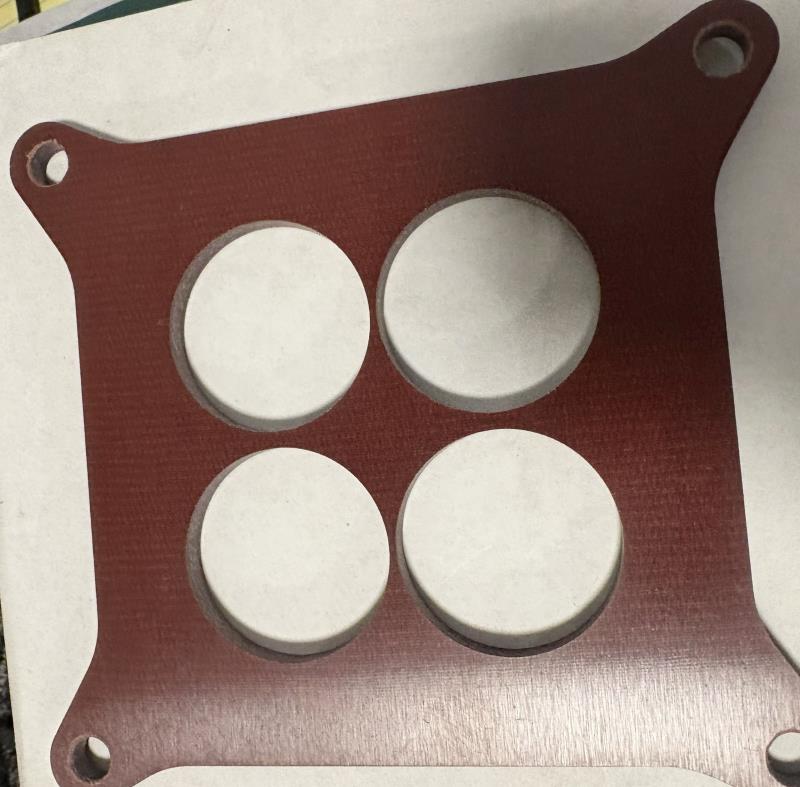 ? ?
|
|
By 55blacktie - Last Month
|
|
Did you test-fit the carburetor by installing your phenolic spacer and then checking for any butterfly clearance issues? As long as there is no interference with the manifold, the larger bores of the spacer should have no adverse effect on performance. Only dyno-testing might confirm a slight difference, whether you use a 4-hole spacer, 2 ovals, or an open spacer, taking into account that they are all the same height/thickness.
|
|
By Joe-JDC - Last Month
|
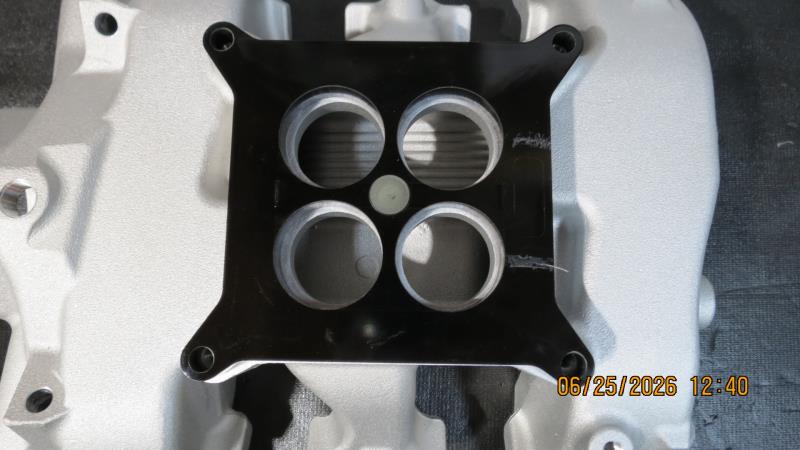 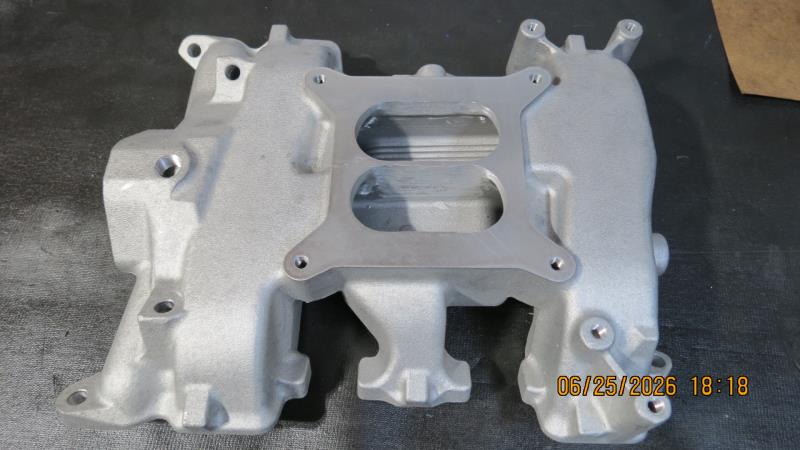 Yes, you need to open up the venturi holes to match the spacer. The lips under that spacer will cause terrible turbulence and be detrimental to your whole idea of getting the engine to run smoothly and accelerate smoothly. That will allow the use of any of the more modern carburetors available. If you stay with the four hole, then slotting the manifold to make a dual oval is not necessary. However, you need to blend the bottom of the holes into the plenum to help the air/fuel turn into the ports easier. Not a difficult task if you have a carbide burr and electric or air die grinder. It is the little things that make any manifold work better. Joe-JDC Yes, you need to open up the venturi holes to match the spacer. The lips under that spacer will cause terrible turbulence and be detrimental to your whole idea of getting the engine to run smoothly and accelerate smoothly. That will allow the use of any of the more modern carburetors available. If you stay with the four hole, then slotting the manifold to make a dual oval is not necessary. However, you need to blend the bottom of the holes into the plenum to help the air/fuel turn into the ports easier. Not a difficult task if you have a carbide burr and electric or air die grinder. It is the little things that make any manifold work better. Joe-JDC
|
|
By RossL - Last Month
|
Joe-JDC (9/24/2026)
Yes, you need to open up the venturi holes to match the spacer. The lips under that spacer will cause terrible turbulence and be detrimental to your whole idea of getting the engine to run smoothly and accelerate smoothly. That will allow the use of any of the more modern carburetors available. If you stay with the four hole, then slotting the manifold to make a dual oval is not necessary. However, you need to blend the bottom of the holes into the plenum to help the air/fuel turn into the ports easier. Not a difficult task if you have a carbide burr and electric or air die grinder. It is the little things that make any manifold work better. Joe-JDC
Should I ask them to enlarge the 4 openings, or create the 2 slotted holes in the bottom picture. What gasket would I use for the bottom configuration?
|
|
By Joe-JDC - Last Month
|
|
If you plan on using the four hole spacer, then have the shop open the holes to match the spacer. Simply install the four bolts and scribe the spacer openings. Opening up the plenum to dual ovals requires an open spacer to scribe the outside edges. If you don't plan on using an open spacer, then only machine the four holes to match the spacer. You have several options with the four holes opened up. 1/4", 1/2", 1", 2" spacers are available with four holes. Joe-JDC
|
|
By RossL - Last Month
|
Joe-JDC (9/25/2026)
If you plan on using the four hole spacer, then have the shop open the holes to match the spacer. Simply install the four bolts and scribe the spacer openings. Opening up the plenum to dual ovals requires an open spacer to scribe the outside edges. If you don't plan on using an open spacer, then only machine the four holes to match the spacer. You have several options with the four holes opened up. 1/4", 1/2", 1", 2" spacers are available with four holes. Joe-JDC
Do you know the manufacturer of the 4 hole spacer in your picture?
|
|
By Joe-JDC - Last Month
|
|
Edelbrock, Summit, Speedway Motors, Jegs, have spacers in different thicknesses and configurations. Aluminum, plastic, and phenolic. Joe-JDC
|
|
By RossL - 2 Weeks Ago
|
|
Another machine shop opened the 4 holes to match my phenolic spacer. I was able to "re-tune" the carb starting from scratch, no more stall out on full WOT from stop. I am working through a slight stumble from a dead stop, but I feel confident I can manage this. No tuning (many hours) whatsoever got me this far with the other manifold
|