Ted (9/7/2026)
Add this to what Chuck and Kultulz have already brought up.
¾ qt. of oil being used in 1800 miles is not excessive and does not immediately warrant any immediate engine repairs without more checking. You do not mention if this engine is a fresh rebuild or how many miles are on it which would have to be taken into consideration. Beyond potential leaks, the existing oil consumption could be taking place as a result of valve guide wear, worn valve seals, piston rings, etc. Also to be considered is how the vehicle is being driven and/or the condition or brand of the engine oil that’s being used. VR1 20W-50 is typically an acceptable oil for older engines if changed regularly. Leaving it in too long can create problems though and especially on an engine that’s running rich or is experiencing oil contamination due to other fuel related issues. A compression test would initially give you a snap shot look at the condition of the piston rings and possibly point you to looking elsewhere for any potential problems. I have owned this car for close to 3 years. I do not know any history regarding a rebuild. It actually runs very good right now. When I had the heads off to check the head gasket orientation the pistons did not have any stampings indicating they were over bored. The head gaskets were the old style metal type, so there were no tabs to identify if they were installed correctly,which is why I removed the heads.
I drive this car on the highway a lot....... speeds of 75-85 are common. I am talking about this speed (engine RPM's 3000-3500) for 30/45 minutes as I am trying to optimize the cooling system with the air conditioning on. My test run also is "up hill",which is a constant grade for a couple of miles. When I turn around to return home, now going down grade the car runs 3-5 degrees cooler (digital gauge with sensor installed in the stock/head location.
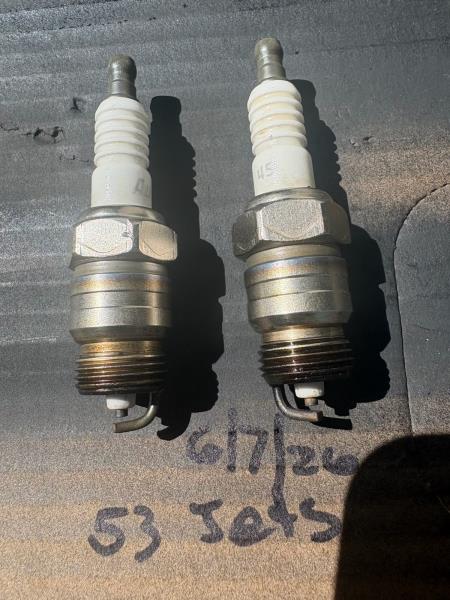
Plugs are white with little tan...... Would a cold engine compression test be of any value? Once the exhaust manifolds are warm it's difficult to screw in the hose without burning my hands for the compression gauge. I always thought a warm engine would give more accurate compression readings, Is there a better tool or some sort of adapter the would be more user friendly on my engine (stock exhaust manifolds)?
Pictures of plugs take a couple of months ago, very typical. These are actually one step colder plugs I bought just to try them. No noticeable smoke out of exhaust or breather (with the PCV valve wouldn't the breather be more of an "input" to the system?