|
By RossL - Last Month
|
|
My 55 Tbird 292. Using Vr1 20/50 used about 3/4 quart in 1,800 miles Is this normal? FYI I am also using a PCV valve for stock valley pan and baffle.
|
|
By MoonShadow - Last Month
|
|
Any leaks appearing?
|
|
By RossL - Last Month
|
No
|
|
By KULTULZ - Last Month
|
Do the plug(s) show oil burning?
Does the PCV SYSTEM show signs of excessive oil? Fumes/mist coning from inlet breather?
How old and tight is the engine? Mayve a dry and wet compression test followed with a leak-down test?
Oil pressure reading(s) with quality mechanical gauge? Why such a heavy oil?
|
|
By Ted - Last Month
|
Add this to what Chuck and Kultulz have already brought up.
¾ qt. of oil being used in 1800 miles is not excessive and does not immediately warrant any immediate engine repairs without more checking. You do not mention if this engine is a fresh rebuild or how many miles are on it which would have to be taken into consideration. Beyond potential leaks, the existing oil consumption could be taking place as a result of valve guide wear, worn valve seals, piston rings, etc. Also to be considered is how the vehicle is being driven and/or the condition or brand of the engine oil that’s being used. VR1 20W-50 is typically an acceptable oil for older engines if changed regularly. Leaving it in too long can create problems though and especially on an engine that’s running rich or is experiencing oil contamination due to other fuel related issues. A compression test would initially give you a snap shot look at the condition of the piston rings and possibly point you to looking elsewhere for any potential problems.
|
|
By RossL - Last Month
|
Ted (9/7/2026)
Add this to what Chuck and Kultulz have already brought up.
¾ qt. of oil being used in 1800 miles is not excessive and does not immediately warrant any immediate engine repairs without more checking. You do not mention if this engine is a fresh rebuild or how many miles are on it which would have to be taken into consideration. Beyond potential leaks, the existing oil consumption could be taking place as a result of valve guide wear, worn valve seals, piston rings, etc. Also to be considered is how the vehicle is being driven and/or the condition or brand of the engine oil that’s being used. VR1 20W-50 is typically an acceptable oil for older engines if changed regularly. Leaving it in too long can create problems though and especially on an engine that’s running rich or is experiencing oil contamination due to other fuel related issues. A compression test would initially give you a snap shot look at the condition of the piston rings and possibly point you to looking elsewhere for any potential problems.
I have owned this car for close to 3 years. I do not know any history regarding a rebuild. It actually runs very good right now. When I had the heads off to check the head gasket orientation the pistons did not have any stampings indicating they were over bored. The head gaskets were the old style metal type, so there were no tabs to identify if they were installed correctly,which is why I removed the heads.
I drive this car on the highway a lot....... speeds of 75-85 are common. I am talking about this speed (engine RPM's 3000-3500) for 30/45 minutes as I am trying to optimize the cooling system with the air conditioning on. My test run also is "up hill",which is a constant grade for a couple of miles. When I turn around to return home, now going down grade the car runs 3-5 degrees cooler (digital gauge with sensor installed in the stock/head location.
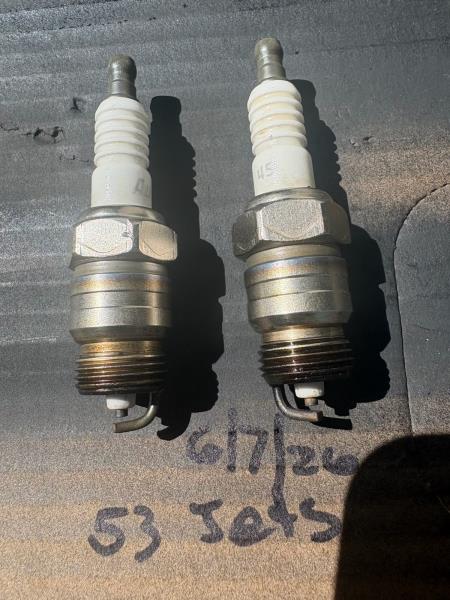
Plugs are white with little tan...... Would a cold engine compression test be of any value? Once the exhaust manifolds are warm it's difficult to screw in the hose without burning my hands for the compression gauge. I always thought a warm engine would give more accurate compression readings, Is there a better tool or some sort of adapter the would be more user friendly on my engine (stock exhaust manifolds)?
Pictures of plugs take a couple of months ago, very typical. These are actually one step colder plugs I bought just to try them. No noticeable smoke out of exhaust or breather (with the PCV valve wouldn't the breather be more of an "input" to the system?
|
|
By Ted - Last Month
|
I do most of my compression checks on engines that are cool as doing them on hot engines can damage the gauge. I change the oil on my ’55 Customline at 2000 mile intervals and while it’s dark indicating that it is time for an oil and filter change, there’s no indication on the dip stick of any oil being used. The 272 engine has well over 200K miles on it since it was last opened up for any work and still runs fine.
Most of my driving takes place with the engine running at 2500 rpm or less as it is a standard shift overdrive car. About thirty years ago I changed out the original 3.89:1 rear gears to a set of 3.56:1 rear gears which made the car happier at the 75 mph highway speeds. I suspect some of your oil usage occurs as a result of running in excess of 3000 rpm for extended periods of time assuming the loss is not related to any oil leakage. Based on the pictures of the two spark plugs, your engine would appear to be fine but a compression test and examining all eight spark plugs would help to alleviate any fears about the engine needing some immediate attention. When performing the compression test, do so with the throttle opened up fully to ensure a full charge of air to the cylinders.
Other comments always welcome.
|
|
By RossL - Last Month
|
Ted (9/8/2026)
I do most of my compression checks on engines that are cool as doing them on hot engines can damage the gauge. I change the oil on my ’55 Customline at 2000 mile intervals and while it’s dark indicating that it is time for an oil and filter change, there’s no indication on the dip stick of any oil being used. The 272 engine has well over 200K miles on it since it was last opened up for any work and still runs fine.
Most of my driving takes place with the engine running at 2500 rpm or less as it is a standard shift overdrive car. About thirty years ago I changed out the original 3.89:1 rear gears to a set of 3.56:1 rear gears which made the car happier at the 75 mph highway speeds. I suspect some of your oil usage occurs as a result of running in excess of 3000 rpm for extended periods of time assuming the loss is not related to any oil leakage. Based on the pictures of the two spark plugs, your engine would appear to be fine but a compression test and examining all eight spark plugs would help to alleviate any fears about the engine needing some immediate attention. When performing the compression test, do so with the throttle opened up fully to ensure a full charge of air to the cylinders.
Other comments always welcome.
Thank you to all for the comments/information.
I've run the same road using the tach keeping it around 2500 RPM, the engine runs about ten degrees cooler. My car has a stock Ford O Matic. I plan to install a Ford AOD transmission this winter to use less RPM's. Since I have to pull the engine for the transmission swap....................this was the reason to inquire about the oil usage.
All eight plus look like the two in the picture. I will make sure to change the oil at 2,000 mile intervals.
What would you consider the tach "redline" for my engine?
|
|
By 55blacktie - Last Month
|
|
Maximum horsepower measured at 4400 rpm.
|
|
By Ted - 4 days ago
|
|
RossL (9/8/2026)
What would you consider the tach "redline" for my engine?
Most stock Y’s I will dyno test up to 5000 rpm. Although most have the HP peaking out before 5000 rpm, they are still making decent power at 5000 rpm and could be pushed further in a real world situation without damage to the engine. These freshly built engines have new valve springs so I’m not worried about valve float resulting in dropped valve at this point in their life.
Those stock engines were notorious back in the day in dropping valves when over-revved with some mileage and age on them. As the engines age, the stock valve springs do get weaker and a 4500 rpm limit should be considered a max rpm. If the engine is nosing over at 4000 rpm or less, then the valve springs should be checked and/or replaced.
|