|
Group: Forum Members
Last Active: 2 days ago
Posts: 1.4K,
Visits: 2.0K
|
cos (7/5/2026)
Hello I have had good results with the ford stock EDB hi lift (.290) blower cam. Ford mentions in supercharged manual that two different cams were used , only used EDB hi lift.. Back in early 60s local Ford YB guys could buy them over the counter for around $18. Oregon cams in Washington State claims to have a original one to pattern a regrind from. Been a few years but cost around $100 if you have a good core. I have a supercharger cam I bought in early 60s but never had timing events checked but lift is .290. .290 lobe lift x 1.54 rocker ratio = .4466 gross valve lift - .019 lash = .4276 net valve lift. What is duration @ .050? LSA?
|
|
Group: Forum Members
Last Active: 4 hours ago
Posts: 205,
Visits: 119.9K
|
Like I mentioned , never had the stock supercharger EDB-E cam timing checked.
|
|
Group: Administrators
Last Active: Yesterday
Posts: 7.6K,
Visits: 206.0K
|
Isky can still grind the Ford 0.290” hi-lift EDB camshaft on brand new blanks. I have been led to believe over the years that Isky was the original supplier to Ford for that particular camshaft and that it was originally designed for the dual quad 285 HP engines. The 285HP engine program was discontinued with the introduction of the supercharger engine and based on the inter-office memos, the first 100 supercharger engines received the 285 HP hi-lift camshaft. That first 100 supercharger engines were all used with standard shift equipped transmissions and were equipped so to be legal for the Daytona race that was coming up. Later supercharger engines received the production ‘D’ and ‘E’ code camshafts as they were more driver friendly when coupled to the automatic transmissions. In running the Isky hi-lift camshaft on period correct normally aspirated iron head engines on the dyno, it’s worth about 15 HP over the factory 1957 272 (B code), 292 (C code), & 312 4V (D code) and 312 8V (E code) camshafts. Camshaft: Iskenderian 301-S-903, solid tappet cam, 1.000” lifter face
Adv duration: 290°I / 290°E
Lobe lift: 0.290”I / 0.290”E
Valve lift: 0.415”I / 0.415E before valve adjustment w/1.43:1 rockers
Valve lift: 0.447”I/0.447”E before valve adjustment w/1.54:1 rockers
Valve lift: 0.464”I/0.464”E before valve adjustment w/1.6:1 rockers
Lobe centers: 110°
Duration @ 0.050”: 234°I / 234°E
Valve lash: 0.016” Int, 0.016" Exh, Hot Here’s the original Ford blueprint for the EDB-D (Supercharger) camshaft showing a completion date of Aug 11, 1956. This pretty much matches the Isky camshaft. 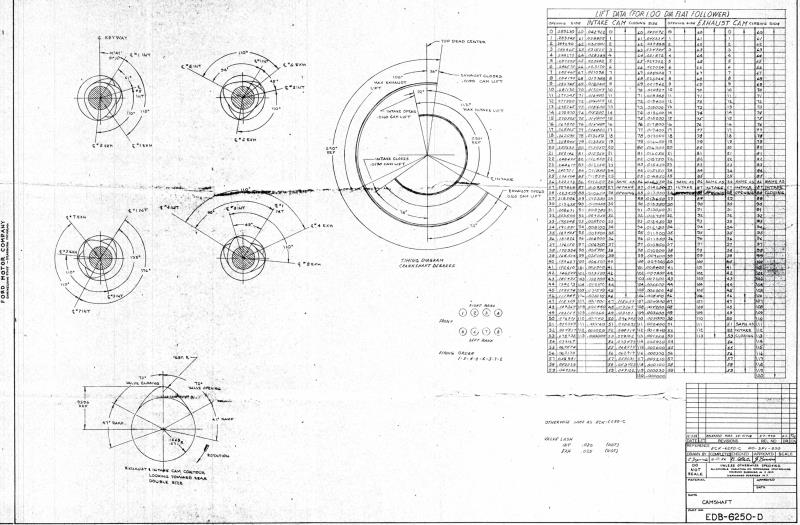
  Lorena, Texas (South of Waco) Lorena, Texas (South of Waco)
|
|
Group: Forum Members
Last Active: 4 hours ago
Posts: 205,
Visits: 119.9K
|
Thanks Ted for info. Always wondered why Ford mentioned two different cams in the supercharger manual. I assume they detuned S/C cars a little for auto trans and street use. Have read the S/C cars build for NASCAR would make over 340 hp but it was all hearsay. Ever had one on your dyno?
|
|
Group: Forum Members
Last Active: 3 hours ago
Posts: 67,
Visits: 699
|
55blacktie (7/3/2026)
Isky's RPM 300, with 112 LSA, isn't going to give you the rough idle that you're looking for. If you're looking for "comparable power to the old low compression 292", why are you considering a supercharger? For camshafts, an Isky 301444 (E4) with an even tighter Lobe Separation Angle (LSA) than the advertised 108, might come closer to having the "rough idle" you want. Keep in mind that the tighter LSA will provide less vacuum at/near idle, In case you have power brakes. So it was a little vague, that's my fault. what I'm saying is as long as it doesn't make less power than the current engine at any point it will be good. Has no vacuum accessories, and manual trans. Seth
|