|
Group: Forum Members
Last Active: 8 Months Ago
Posts: 470,
Visits: 183.3K
|
All of my intake valves have a fairly heavy and equal carbon deposits on the backsides. About 20,000 miles on engine. New valves, guides and Teflon seals. exhaust valves are normal looking. What could be causing this?
"FREE SAMPLE"
|
|
Group: Forum Members
Last Active: 3 days ago
Posts: 1.4K,
Visits: 2.0K
|
Too rich? What do your spark plugs look like?
|
|
Group: Forum Members
Last Active: Yesterday
Posts: 24,
Visits: 7.8K
|
Are you running a PCV valve?
|
|
Group: Administrators
Last Active: 2 days ago
Posts: 7.6K,
Visits: 206.0K
|
At the top of my list, it’s oil that’s creeping down the guides. You might recheck the stem to guide clearance along with the condition of the seals. Using the engine for braking can create a high vacuum demand which will cause more oil than normal to be pulled down those guides and deposited on the valves. Another contributing factor is the engine running on the cool side and not allowing the deposits to be cooked off. This could be a result of running without a thermostat, using a low temperature thermostat, and/or short drives where the engine is not getting thoroughly warmed up. And another consideration is the fuel and how clean it is. High sulphur compounds in the fuel and/or supplements or additives added to the fuel should also be considered.
  Lorena, Texas (South of Waco) Lorena, Texas (South of Waco)
|
|
Group: Forum Members
Last Active: 8 Months Ago
Posts: 470,
Visits: 183.3K
|
The plugs look normal
"FREE SAMPLE"
|
|
Group: Forum Members
Last Active: 8 Months Ago
Posts: 470,
Visits: 183.3K
|
No. Stock road draft system.
"FREE SAMPLE"
|
|
Group: Forum Members
Last Active: 8 Months Ago
Posts: 470,
Visits: 183.3K
|
A man at the machine shop said "A lot of cam overlap". 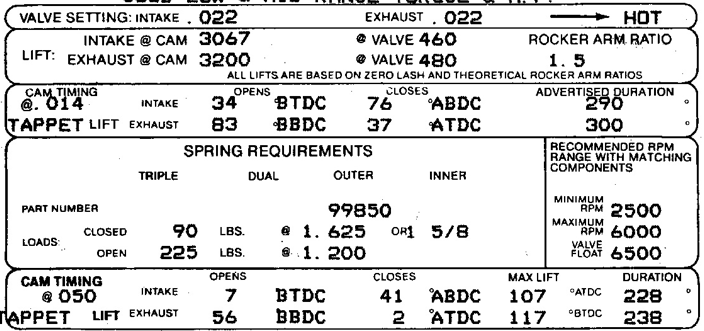 "FREE SAMPLE"
|
|
Group: Forum Members
Last Active: Yesterday
Posts: 2.0K,
Visits: 306.5K
|
What is it you are working on and how was the engine built?
____________________________
|
|
Group: Forum Members
Last Active: 3 days ago
Posts: 1.4K,
Visits: 2.0K
|
Looking at your cam card, your intake opening & exhaust closing at .014 lift (advertised) equals 71 degrees overlap; however, your LSA (107 + 117 divided by 2) is 112. Isn't 71 degrees overlap for a cam that has a 112 LSA unusual? Ted did mention that there would be less overlap with a 112 LSa, but the numbers still add up to 71 degrees overlap. Am I missing something?
|
|
Group: Administrators
Last Active: 2 days ago
Posts: 7.6K,
Visits: 206.0K
|
Some more thoughts on the subject. The 228/238° @ 0.050” camshafts are a common camshaft for both the Ford Y and others on my end. These do not promote any excessive carbon build ups on the intake valves even when ground on 110° lobe centers. Your camshaft being ground on 112° lobe centers will have even less overlap at the valves than what you would see with a camshaft ground on 110° lobe centers. With all that in mind, then I would be looking for another underlying cause. Oil seepage down the guides is still at the top of my list but here are some other considerations. You say your spark plugs look normal so for the most part I would rule out excessive oil getting past the rings. A leak down test would help to ensure that the rings are indeed doing their job. Something else to consider would be excessive exhaust back pressure which is forcing exhaust pressure to be backed up into the intake tract during the overlap cycle. The camshaft being installed with excessive advance could also increase the propensity for that carbon build up on the intake valves both from the standpoint of increasing the manifold vacuum and also increasing the amount of time that the open intake valve is exposed to any potential exhaust flow. And don’t forget the valve lash. Increasing the valve lash increases the manifold vacuum while decreasing the valve lash increases the amount of overlap at the valves.
Lorena, Texas (South of Waco)
|