|
Group: Administrators
Last Active: 6 hours ago
Posts: 7.6K,
Visits: 206.0K
|
|
|
Group: Forum Members
Last Active: 8 Years Ago
Posts: 21,
Visits: 5.3K
|
Very cool! Looks like Joe is loaded for bear. Wishing you the best of luck this year Ted.
|
|
Group: Administrators
Last Active: 6 hours ago
Posts: 7.6K,
Visits: 206.0K
|
Still waiting on four pistons to arrive. I’m told that the coatings on the four replacement pistons are the hold up. In the meantime, I have balanced the crankshaft assuming the forthcoming pistons are the same weights as the ones I already have on hand. I plan on installing the crankshaft in the block and degreeing in the camshaft just to speed things up a bit. I’ll only install one rod and piston for this to find TDC as I’ll likely need to tweak the weight on the current four pistons when the four new ones arrive. Murphy’s Law seems to rule in cases where you’re in a time crunch.
  Lorena, Texas (South of Waco) Lorena, Texas (South of Waco)
|
|
Group: Forum Members
Last Active: 8 Years Ago
Posts: 21,
Visits: 5.3K
|
Ted can you share a little bit about your combo this year?
|
|
Group: Forum Members
Last Active: 3 Years Ago
Posts: 1.4K,
Visits: 179.6K
|
Best Wishes to Ted, Joe, Royce and Jon Kaase in the upcoming competition! I'm looking forward to the first week of October. GO Y-BLOCK GUYS!  NoShortcuts
a.k.a. Charlie Brown
near Syracuse, New York
|
|
Group: Administrators
Last Active: 6 hours ago
Posts: 7.6K,
Visits: 206.0K
|
HenryFloored (9/11/2018)
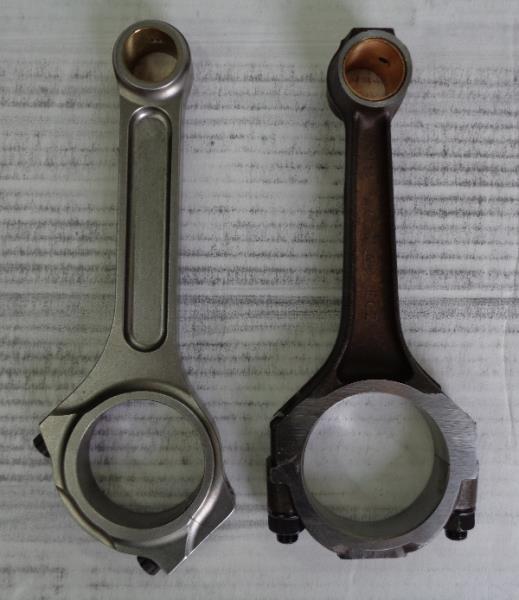
Ted can you share a little bit about your combo this year?Bore is 3.862” while the stroke is 4.300”. Not a typo on the stroke as this is a one inch stroker. A one inch stroker just has a better ring to it than the ¼” or 3/8” strokers that were made back in the day for the various engines. And that extra 0.300" stroke over the 2016 engine combination yields an additional twenty eight cubic inches. The camshaft is still a standard base circle so any clearance issues that were going to take place between the connecting rods and the camshaft lobes is rectified by angling the connecting rod big end parting line ~45° which effectively moves the rod bolt boss on the connecting rod out of the way of the camshaft. No other clearance issues within the Y with this much stroke; the camshaft to rod clearance was an issue even when Ford went from a 3.3” to a 3.44” stroke so you can imagine what going to a 4.300” stroke did in that area. I’m planning on running the same heads and intake that I ran on the 2016 EMC engine along with the same camshaft grind. That camshaft was on the large side for the 2016 combination so it should fall more in line with 28 more cubic inches to work with. Engine should have been completed by now and dyno testing done but it looks like it will still be warm when it’s loaded on the truck for the trip to Mentor, Ohio. Rod comparisons. EMC rod on the left, 312 rod on the right.
Lorena, Texas (South of Waco)
|
|
Group: Forum Members
Last Active: 8 days ago
Posts: 903,
Visits: 13.9K
|
Nice stuff
|
|
Group: Forum Members
Last Active: Last Month
Posts: 457,
Visits: 22.3K
|
a picture is worth a thousand words.
|
|
Group: Forum Members
Last Active: 8 Years Ago
Posts: 21,
Visits: 5.3K
|
Wow Ted! That 4.300” does have a very nice ring to it. Should be a torque monster.
I’ll bet your cylinder heads can feed all those inches as well.
Love the angled rod solution. I take it those are custom rods. Any reservations about their durability?
Love to see these full on efforts put into these old Ford engines. It’s neat to see what can be done with them.
Best of luck to you sir.
|
|
Group: Forum Members
Last Active: Yesterday
Posts: 787,
Visits: 23.1K
|
Got a couple of clarifications on rules today, and they do not require mufflers, can use air cleaner base, stub stack, or velocity stacks, but must run water pump with fan belt that is engine driven. So, things are getting close to show time. Ted is building a torque monster for sure. Joe-JDC
JDC
|