|
Group: Forum Members
Last Active: Last Week
Posts: 789,
Visits: 113.4K
|
Greetings to all: I'm not an expert on the intricate dynamics of valve train operation but will try to offer a few things from an old memory. A coil spring has a natural tendency to tighten the coil, that is, reducing it's outside and inside dimensions, when compressed. The opposite happens when released. I may have the direction of coiling and uncoiling wrong but the point is either direction will produce a rotational effect. There are, as we know, one piece retainers and 2 piece retainers available. With the 2 piece retainers, it's the inner section that is often referred to as a rotator. At some speed there are natural harmonics going on, and with the natural "coiling/uncoiling tending to rotate the spring and the ability of the spring retainer free to turn against the inner piece, rotation can happen. Not sure how constant or predictable it is. Adding an inner damper spring and/or changing to1 piece retainers, one or both may prevent the natural rotation tendency. Find something similar to an old fashioned door closing spring, secure one end in a vise, tie a short length of string on the springs free end and stretch it. It soon becomes evident how much the free end rotates. Again, I can't remember which action produces what direction of rotation. Just some food for thought, thanks for reading, JEFF..........................
64F100 57FAIRLANE500
|
|
Group: Forum Members
Last Active: Last Week
Posts: 789,
Visits: 113.4K
|
Ted was faster at the trigger than I. Well said Ted.......................
64F100 57FAIRLANE500
|
|
Group: Forum Members
Last Active: 1 hour ago
Posts: 772,
Visits: 22.6K
|
I will agree that spring harmonics cause valve rotation, but the pushrods and lifters do not. Joe-JDC
JDC
|
|
Group: Forum Members
Last Active: Last Week
Posts: 789,
Visits: 113.4K
|
Extremely amazing videos. I would think an engine with solid lifters would tend to promote valve rotation more so than an engine with hydraulic lifters? Thanks Ted for the links. EDIT: I base this on the fact that for a certain time during the cycle, the rocker is at zero contact with the valve stem allowing more freedom of movement.
64F100 57FAIRLANE500
|
|
Group: Forum Members
Last Active: 3 Years Ago
Posts: 513,
Visits: 153.3K
|
"The intake and exhaust valve assemblies are the rotating type." So sayeth the Ford Shop Manual.
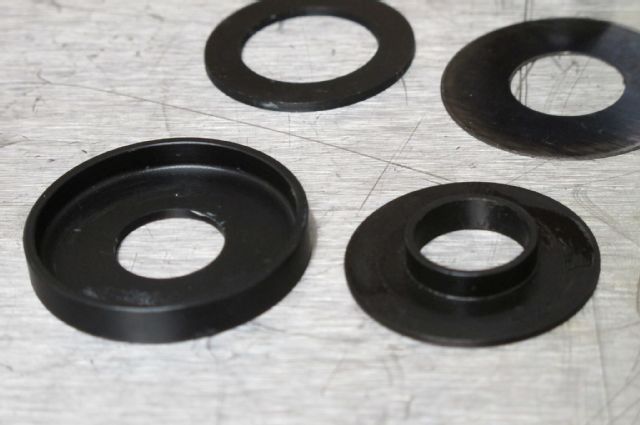
Eickman's book pg. 25 sez "The valves in a Y-block were equipped with rotators to pro-long valve face life. The rotator was simply a tapered sleeve in which the keepers were seated. This sleeve was in turn seated in the retainer. The rotator served to reduce the contact area with the retainer, which enabled the valve to turn in the retainer and valve spring."
|
|
Group: Forum Members
Last Active: Last Month
Posts: 1.7K,
Visits: 340.1K
|
In all the photos you can see the "paint" removed from springs and can just imagine what the bottom edge of the spring that rests on a cast iron head is doing. These are good reasons for using steel shims under valve springs and buy a very very good oil filter,,....
56 Vic, B'Ville 200 MPH Club Member, So Cal.
|
|
Group: Forum Members
Last Active: 3 days ago
Posts: 1.8K,
Visits: 306.3K
|
____________________________
|