|
By Skyliner57 - 2 Months Ago
|
|
I would like to convert my drum brakes to disc on a 57 Ford Skyliner. I have Granada wheels/. What is the best conversion kit?Thanks
|
|
By KULTULZ - 2 Months Ago
|
|
Let me ask you, is the car a survivor, restore or driver?
Why do you feel the need for a FRT DISC CONVERSION?
You are retaining 14in steel wheels w/ full wheel covers?
|
|
By 55blacktie - 2 Months Ago
|
KULTULZ (8/4/2026)
Let me ask you, is the car a survivor, restore or driver?
Why do you feel the need for a FRT DISC CONVERSION?
You are retaining 14in steel wheels w/ full wheel covers?
When I inherited my 55 Tbird, the original drum brakes functioned as designed: however, I have installed Wilwood 4-piston Dynalite front discs, Wilwood dual-circuit master cylinder, and proportioning valve. My friend also has the Wilwood front disc brakes, but he used a 1967-71 Mustang dual master cylinder.
I can't say that one kit is better than others; you can choose the Kelsey-Hayes-type 4-piston calipers as found on pre-67 Mustangs/w 14-inch wheels or 67-up single-piston calipers.
Front disc brakes are a definite improvement, if your car is a driver, not a trailer queen. As far as rear discs go, they're pretty much a waste of money, unless you intend to go road racing (on a track, of course).
|
|
By KULTULZ - 2 Months Ago
|
The K-H 4-PISTON CALIPER STYLE is the way to go (IMO), but being a RTH ... (RHT)
RETRACTABLE HARDTOP
I would like to know know how far he wants to go from originality, especially booster and MC.
It will retain the OEM SPINDLES.
No. 1 - WILWOOD No. 2 -- LEEDS or similar No.3 - OTHER
|
|
By Skyliner57 - 2 Months Ago
|
|
Thanks for the reply. The car has been restored, runs and drives well. The car is heavy, and I would like to have it stop better. I have a set of 14 Granada wheels that will accept my stock full hub caps. I would like to do the front. I currently have a dual master cylinder and Master Power Brake booster installed.
|
|
By KULTULZ - 2 Months Ago
|
So you have a driver and are only concerned with drive-ability and not necessarily originality or appearance?
Is the current dual reservoir MC DRUM/DRUM or DISC/DRUM?
|
|
By Skyliner57 - 2 Months Ago
|
|
I would plan to replace the current master cylinder with one designed for disc brakes. I like to see that the Wilwood is preferred over the Leed. always appreciate the reply's. Harold
|
|
By KULTULZ - 2 Months Ago
|
|
|
|
By 55blacktie - 2 Months Ago
|
Skyliner57 (8/5/2026)
I would plan to replace the current master cylinder with one designed for disc brakes. I like to see that the Wilwood is preferred over the Leed. always appreciate the reply's. Harold
Although I have a Wilwood master cylinder, I don't know that there's anything special about it (other than appearance). My friend didn't use the Wilwood master cylinder, even though he did use the Wilwood brake kit. Your master cylinder should work, but I would install an adjustable proportioning valve and a 10-lb. residual valve for the rear drums.
|
|
By KULTULZ - 2 Months Ago
|
|
Just a brief comment ...
A DRUM/DRUM MC will not work on a DISC/DRUM setup.
It will not generate enough line pressure to energize the calipers properly.
WILWOOD is eye-candy to me, though quality is exceptional.
And don't fall for the cheese-grater rotors for the street. Strictly eye-candy and $$$.
|
|
By Skyliner57 - 2 Months Ago
|
|
I currently have a proportioning valve, not sure about the residual. Thanks for the information. Harold
|
|
By 55blacktie - 2 Months Ago
|
Replacing a drum/drum master cylinder often is recommended, one of the reasons for which is that drum/drum master cylinders typically have smaller bores. However, my original 55 Tbird's master cylinder had a 1-inch bore. Although it had manual brakes, I'm pretty sure that the same master cylinder was used for cars equipped with power brakes. However, Wilwood recommended a 15/16ths bore for my disc/drum application; that's what I bought.
Some master cylinders have an integral residual valve. There are some recommendations for a 2-lb. residual valve for front discs and 10 lb. for rear drums. Wilwood only recommended the residual valve for the rear drums.
|
|
By DryLakesRacer - 2 Months Ago
|
|
I used Wilwood's also on our 1956 Victoria. I did not want was a vacuum can on my firewall and they suggested their smallest diameter MC and to install smaller wheel cylinders on the rear drum brakes I had added with a 8.8 rear install. Everything went fine and I'm pleased. The pedal pressure is less than the original 4 drums but not touchy like power assist. They recommended an adjustable push rod from a Mustang. I bought everything from Summit at their suggestion to save a few dollars.. I am local to them and their technical support for me was top notch.
|
|
By paul2748 - 2 Months Ago
|
|
Typically, drum/drum master have an integral residual pressure valve, even the dual bowl units. . Disc/drum masters do not have it and that is why most, if not all systems, use a separate combination valve (residual pressure, balance valve) . One seems to be shown in the picture posted.
|
|
By KULTULZ - 2 Months Ago
|
Well, RPV(s) were standard on either a DUAL RESERVOIR DRUM-DRUM or DISC/DRUM (drum brake circuit) until about 1972 when FORD deleted the RPV and went to drum wheel cylinders using a cup expander design. As you can no longer buy original FORD (other than NOS) the aftermarkets may come through with or without. You have to know.
Same with a METERING VALVE as FORD changed MC calibration to negate them.
A 2# RPV on a DISC circuit is only used when the caliper is mounted below MC level.
The standard bore/piston size for a K-H design 4-piston caliper MC is 1 inch unless the car was/is a HP car.
The system has to have an adjustable PPV valve to control weight bias, especially in a panic stop situation. A METERING VALVE is suggested for proper performance and front pad longevity.
WILWOOD does not offer power assist so if wanted has to be sourced from another vendor.
1957 FORD DRUM/DRUM manual MC bore size was 1" while power assist was 1 1/8"
You have to cipher exactly what it is you are trying to do and plan/buy from there.
Using GM style braking system(s) is a completely different story.
|
|
By KULTULZ - 2 Months Ago
|
" ... currently have a proportioning valve, not sure about the residual. Thanks for the information. Harold" Where did you source the DRUM/DRUM MC? 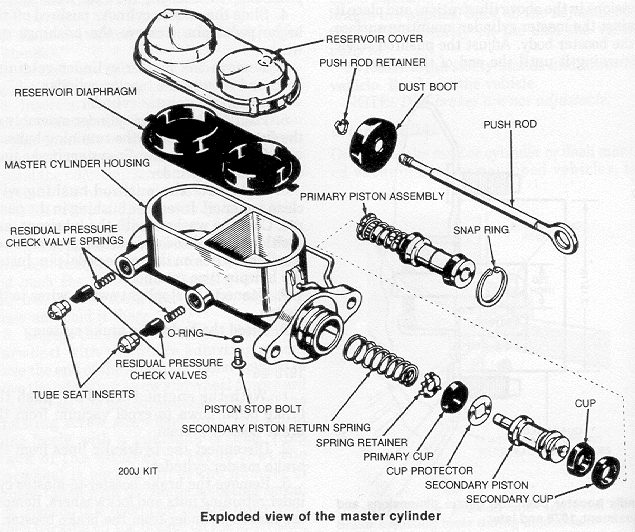 |
|
By Skyliner57 - 2 Months Ago
|
|
The Master Cylinder was installed many years ago, maybe from NAPA. I was told by the Wilwood guy to use 3/16" brake line instead of the 1/4". Any comments. Thanks. Harold
|
|
By KULTULZ - 2 Months Ago
|
WILWOOD was correct about line sizing (IMO).
What you are trying to do is update the original braking system to a later design. It would be best (IMO) to also use whatever line size as used on the later design system for retrofit. But shoe size and wheel cylinder size(s) also come into play here.
Did I read an earlier post correctly saying you have a PROPORTIONING VALVE in the present system?
|
|
By KULTULZ - 2 Months Ago
|
BTW ... You will want a minimum of 3/16-in line on the front disc circuit to allow for greater fluid volume movement.
If the rear shoe size and wheel cylinder bore size is left stock, 1/4-in rear drum line size should be good for a non-HP street car. |
|
By RossL - 2 Months Ago
|
I installed the disc brake kit purchased from Hills for my 55 Tbird. The kit was developed by a guy that retired and Hills now sells it. The parts seem to be repro Ford and most parts arrived in NAPA boxes (part numbers removed). My car had power brakes. After installing the kit, I thought the discs needed more pedal pressure to stop comfortably. I installed a Midland C490 booster (recommended by Hills) and it improved the stopping power eliminating the need for the heavy leg pressure required for the "final" stop. That booster was designed for a Dodge truck. It's out of production expensive hard to find. They do come up on eBay usually $1,000. It has a larger vacuum can, smaller piston with longer throw to produce more pressure
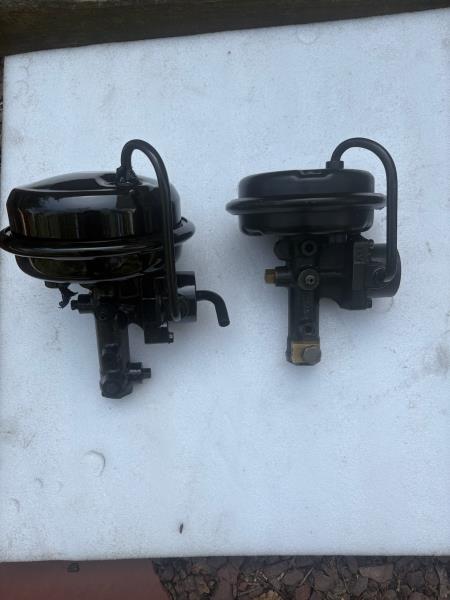 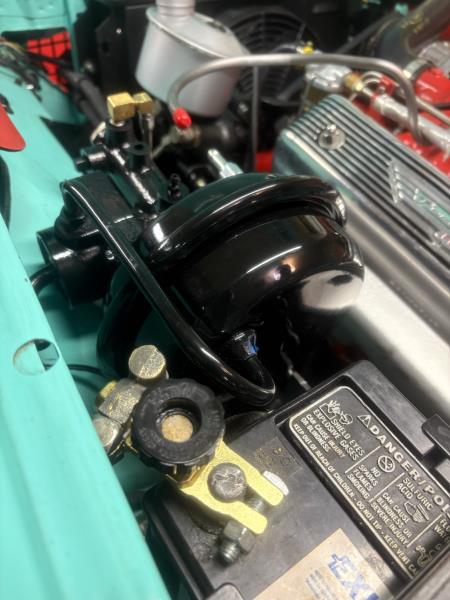
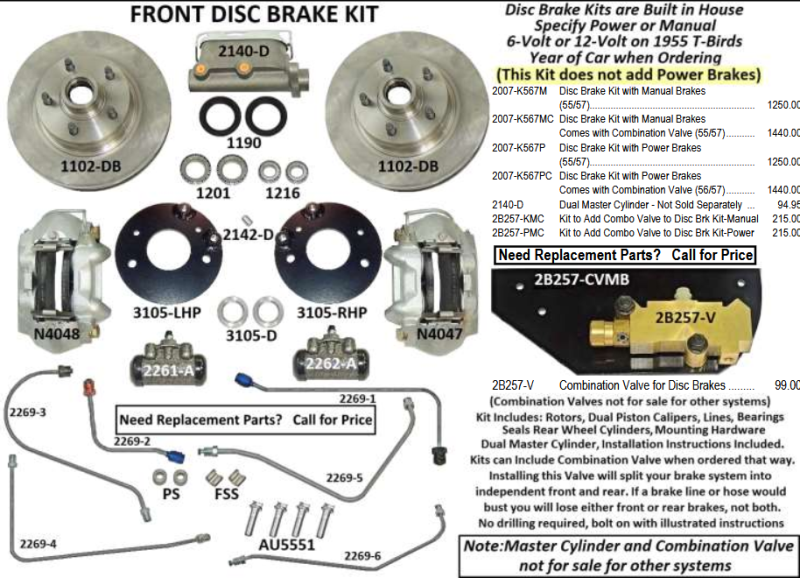
|
|
By KULTULZ - 2 Months Ago
|
|
After installing the kit, I thought the discs needed more pedal pressure to stop comfortably. I installed a Midland C490 booster (recommended by Hills) and it improved the stopping power eliminating the need for the heavy leg pressure required for the "final" stop.
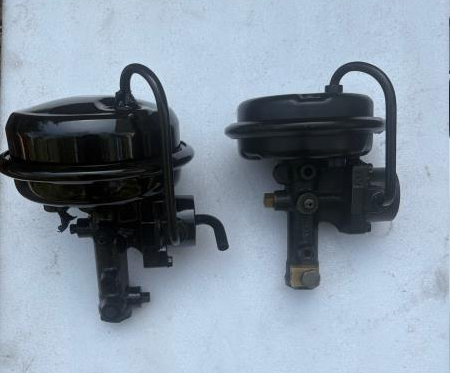 INTERESTING - THANX! |